White Javanese Jedi Knight

White Javanese Jedi Knight

Wednesday, 22 July 2015

Simply the Best Images from Indonesia (no 9).

Simply the Best Images from Indonesia (no 9).
I Continue My Mission. My Only Answer.  Replace The Bad Images by The Good Ones.


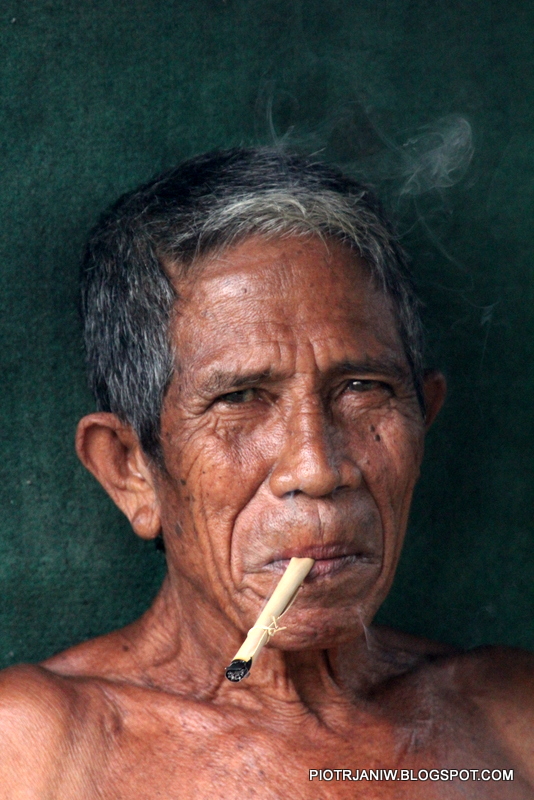
Bapa Mualim. The oldest man living on Earth?

Bapa Haji Mualim Sidik.
Bapa Mualim.
Jakarta. Pondok Indah.

120 years old.
14 kids.
30 grandchildren.
2 cigarette packets per day.

Is he the oldest man living on Earth?
According to him and his family he's 120 years old.

According to Wikipedia the oldest man ever, whose age has been verified, was Jiroemon Kimura (1897-2013) a Japanese man who died at the age of 116 years.

Bapa Mualim.
Maybe he's 120. Maybe not. What importance!
He's still in perfect health. Some minor hearing problems. But still reading without glasses. Still perfectly mobile. No gray hair. Perfect brain capacities. Memory. Still perfectly remembering Dutch colonial era or Japanese occupation. 

Bapa Mualim.
He's simply Amazing!
And he's smoking. Smoking like chimney! Completely crazy! Destroying all my beliefs about cigarettes threat!
The proof, that cigarettes are not bad for everyone. And can be compensated by healthy and happy life.
Doesn’t drink alcohol (Muslim). Doesn’t eat rice or bread. But eats cassava.
Living in healthy environment. Having Friends and Smiling, Lovely, Happy Family.

Is this the magic recipe for a long and happy life?
And why not?

https://www.washingtonpost.com/news/to-your-health/wp/2015/09/10/long-lived-smokers-may-be-a-biologically-distinct-group-with-an-extraordinary-gene-network/

http://piotrjaniw.blogspot.com/2015/07/indonesians-heavy-smokers-happy-people.html


Related post:
Heavy and Happy Indonesian Smokers. 

http://piotrjaniw.blogspot.com/2015/07/indonesians-heavy-smokers-happy-people.html

Tuesday, 21 July 2015

Why Some Cultures Think Pork Is Bad and Others Think It’s Delicious. Disgusting Pig Toilets.

Why Some Cultures Think Pork Is Bad and Others Think It’s Delicious.
Why I stopped to eat Pig meat. Disgusting Pig toilets.


Pig meat: It's a weirdly polarizing subject. In some cultures, it's a mealtime staple; in others, it's considered so unclean that there are entire dietary laws and rituals governing what to do if a plate comes into contact with a piece of bacon.

What accounts for this difference?

As is so often the case when it comes to explaining human culture, it probably goes back to stuff that happened a long, long time ago.
Given that codified pig-aversion appears to have first arisen thousands of years ago in what is today Israel and Palestine. The mostly popular explanation [for some cultures' aversion to pig meat] — that the ban protected against trichinosis — is almost certainly untrue (there's no evidence the parasite existed in ancient Palestine, and other meats could be equally dangerous).

Rather the best way to understand this cultural difference is to look at places where pig meat has been not only tolerated, but enthusiastically devoured.
Just across the Mediterranean ... the Romans loved swine with a passion matched by few people before or since. Romans sacrificed pigs to their gods and created an elaborate pork-based cuisine, including some dishes — such as roast udder of lactating sow — that could make even a gentile shudder.

What accounts for these differing views? In the Near East, an arid land, most pigs lived as urban scavengers. The Italian Peninsula, by contrast, boasted vast oak forests, and Rome imported wheat by the shipload. Rather than eating garbage in the streets, Roman pigs spent their days dining on acorns and grain.

The reputation of pork depends upon the life of the pig. In early medieval Europe, when most pigs foraged in the woods, pork was the preferred meat of the nobility. By 1300 most forests had been felled, and pigs became scavengers. In a medieval British text, a woman explains that she won't serve pork because pigs "eat human shit in the streets." Pigs also dined on human flesh, which was available because executed prisoners, among others, were left unburied. In Shakespeare's Richard III, the title character is described as a "foul swine" who "Swills your warm blood like wash, and makes his trough / In your embowell'd bosoms." An Irish religious text noted, "Cows feed only on grass and the leaves of trees, but swine eat things clean and unclean."

It's interesting to think that deeply held religious beliefs — and deeply loved meals — may go back to the random question of whether one's ancestors, or the people one's ancestors traded with or were converted by, hung out with (gross) city-pigs or (wholesome) country-pigs
.
Why I stopped to eat Pig meat?

In South Korea.  2 years ago. When visiting traditional Korean village I discovered the Pig toilet concept.

A pig toilet is a simple type of dry toilet consisting of an outhouse mounted over a pig sty with a chute or hole connecting the two. The pigs consume the feces of the users of the toilet. Pig toilets were once common in rural China, India and Korea.

They could still be found in remote northern Chinese provinces. In Goa and Kerala states on the west coast of India, 20 % of the population is still using pig toilets. In Korea one culinary specialty is “ddong-duedji” (lit. shit-pig): pork from pigs that have been fed only with human feces for their entire “lives”.

Pig toilets are ecologically and economically perfect!  Efficient and cheap. No piping. No sewers. No cesspool. No stink.

BUT THEY ARE TOTALLY DISGUSTING


That stick you see is to push the pig away if it comes up to you while you're doing your business.  


Growth is death. How our economy is killing the Earth. We must think big to fight environmental disaster.


How our economy is killing the Earth
We must think big to fight environmental disaster

Some interesting pieces of text from New Scientist.


Growth to most economists is as essential as the air we breathe: it is, they claim, the only force capable of lifting the poor out of poverty, feeding the world’s growing population, meeting the costs of rising public spending and stimulating technological development – not to mention funding increasingly expensive lifestyles. They see no limits to that growth, ever.

But there is a long-standing question: how to increase Earth’s finite resources with the fact that as the economy grows, the amount of natural resources needed to sustain that activity must grow too?

The economy expansion is vain as long as our economic system is built on the assumption of growth.

The graphs climbing are a stark reminder of the crisis facing our planet.

Consumption of resources is rising rapidly, biodiversity is plummeting and just about every measure shows humans affecting Earth on a vast scale.


If we are serious about saving Earth, we must reshape our Economy. There is the need for a more sustainable way to live, by reducing carbon emissions, developing renewable technology and increasing energy efficiency.

The Paradox of Capitalism

There is a paradox at the heart of capitalism. It is the result of two contradictory truths.

The first truth is that capitalism is destroying our planet. Through global warming, extinction, impoverishment, racism, sexism, homophobia, propaganda, war, the burgeoning security state, computerized isolation, and more, it is literally killing us.

The second truth is that we are dependent upon capitalism for our immediate survival. Whether through wages, pensions, or social services, our livelihood depends on income provided by the very system which is killing us.

Some among us are facing the first truth and so do whatever they can to escape. They may adopt an ethical diet, curb their consumption, or even attempt to “live off the grid”. Its goal is moral purity, flight from guilt, the individual satisfaction of knowing you’re no longer part of the problem.

Some of us are more concerned with the second truth – the fact that we are trapped in this system as bad as it is, and therefore the best we can do is to improve it or make it fairer. They may fight for policy changes. The aim is to work “within the system,” influence the people in charge. The theory goes that they would be able to steer the ship in a new better direction.


We live in a paradoxical world; the most important truths are the hardest to uncover, and the entire world is drowning in lies. How can we expect any easy answers to our current problem? 
The simpler idea, the emptier it tends to be. Truth lives in complexity and contradiction. 

To liberate the world and ourselves, we must be able to hold these two opposites truths in our minds at the same time, recognizing that neither is sufficient and yet both are necessary.

Sunday, 19 July 2015

Indonesians. Heavy smokers. Happy people.


The Indonesia exception.

Heavy smokers. Happy people!!!


The Indonesia exception. Heavy smokers. Happy people!!!


After more than 5 years spending in Indonesia I still have  the  same question: What makes the Indonesians the happiest people on the Planet Earth?

I'm still trying to understand what is the source of their  happiness?

Why Indonesians are more happy than others? Definitely they are living in a Paradise environment :))). Maybe this fabulous location make them happier than others? Other nations? But what is the difference btw Indonesia and Philippines for example? Or Malaysia? Same environment. Same ethnics. Same religion (with Malaysia). And the Indonesians are still .....100 times more happy!!!

What is the answer?

Religion? (But which one? Islam?)

Environment? (Islands? Sea? Volcanic ash in the  air? :)).

Weather? (Sun quantity. No strong rain. No hurricanes. No winters. Almost no cloudy days).

Food abundance ? (No winters, perfect agriculture conditions with fertile volcanic lands, hot-wet climate. So plenty of food available all over the year. No need to fight hard to survive).

Type of Food? (Seafood? Spicy food? Sambal? It's killing all bad demons inside the body!  :)).

No-alcohol culture? (But only for Muslims).

Or something else?


I think I've just found the right answer!!!

There is one another discipline where the Indonesians excel.  Another area where Indonesia is the number one! By far!

Smoking! Cigarettes smoking!

The nicotine consumption make them so happy?
That  evident correlation can be used by Big Tobacco to defend the cigarette smoking!!! :)))


Bapa Haji Mualim Sidik.
Jakarta. Pondok Indah.

120 years old.
14 kids.
30 grandchildren.
2 cigarette packets per day.


https://www.washingtonpost.com/news/to-your-health/wp/2015/09/10/long-lived-smokers-may-be-a-biologically-distinct-group-with-an-extraordinary-gene-network/


Full article from The Economist
Jul 11th 2015

Quitting is so hard


Everybody now knows how people can be persuaded to stop smoking. So all countries should be doing it.

SOLVING some of the world’s great health problems, such as cancer and Alzheimer’s disease, remains beyond the wit of science. Not smoking. For over a decade, it has been clear what countries need to do to get people to quit. Yet although rates continue to fall in some countries—such as America and Britain—elsewhere they are rising. That’s true not just in the poor world, where people are getting prosperous enough to take up the habit, but also in bits of the rich world: on some measures rates are plateauing in Germany, France, Belgium and Portugal after decades of decline. It is time to push them down.

Banning smoking would be wrong. It would be not only illiberal—people should be allowed to indulge in their pleasures, even lethal ones—but also ineffective. As the decades-long “war on drugs” shows, when people really want to get hold of a mind-altering substance, be it heroin or tobacco, they will. Bans on legal sales fuel illegal ones. But discouraging smoking is entirely legitimate: smokers pollute the air other people breathe, they damage their families when they die prematurely, and the addictive nature of the habit weakens the argument that smoking is a freely chosen pleasure.
The most effective measure against smoking is taxation. Fiscal engineers need to be careful to set the rate neither so high that it encourages smugglers, nor so low that it fails to deter smokers. The WHO reckons that it should be at least three-quarters of the value of a pack. And, as they raise the tobacco tax, governments need simultaneously to tighten their borders. Britain cut the smugglers’ share of the market from 21% to 9% by sharpening customs operations.

Bans on smoking in public places can have immediate benefits. In eight countries in Europe and the Americas, admissions to hospital for heart disease fell by an average of 17% in the year after the implementation of such a ban. Gruesome public-information campaigns can help. America’s “Tips From Former Smokers” campaign, which showed people crippled by smoking-related diseases, persuaded around 100,000 people to quit. At a cost of $480 per person, it was a good investment: according to a Danish study, the lifetime benefits to men of giving up smoking at 35 are around €25,000 ($27,400), most of that in increased productivity. Costa Rica and the Philippines send aspiring quitters text messages with handy tips on giving up: a trial suggested that doubled quit rates. And electronic cigarettes can help: 7% of British quitters use them.
But according to a WHO report published on July 7th, Turkey is the only country to have introduced all the necessary measures. Some countries, such as Indonesia, still have hardly any regulations. Others have too many loopholes. In France, for instance, the availability of covered patios undermines the ban on smoking in restaurants.

For governments that overcome tobacco-company lobbying and political inertia, the benefits can be huge. After Turkey adopted its comprehensive package, the male smoking rate dropped from 52% to 41% in eight years. In Europe 30% of those who have ever smoked are now ex-smokers. Getting people to quit at that rate in China, where 1.4m a year die early from tobacco, would avoid 35m premature deaths.


The idea of developing countries leapfrogging rich ones is familiar in technology, but it can apply to social policy, too. Over the past half-century, the rich world has learned slow and painful lessons about how to persuade people not to take up smoking, or to quit it if they already have. Low and middle-income countries can adopt those measures before their citizens get addicted. At virtually no cost, many millions of people can be saved from painful, premature deaths, and their families from misery.